Plan Mode in Claude Code
The single most important workflow pattern I use when building software with AI. Plan Mode forces alignment before code is written, preventing the most expensive mistake in AI-assisted development: building the wrong thing.
Built into Claude Code. No setup required.
# the_problem
When you ask an AI coding assistant to "add authentication" or "refactor the database layer," it immediately starts writing code. Sometimes it's exactly what you wanted. Often it isn't.
The AI picks an approach based on its best guess: JWT when you wanted sessions, a new library when you already have one, a complete rewrite when you needed a targeted fix. By the time you see the output, it has written hundreds of lines of code in the wrong direction.
The cost isn't just wasted tokens. It's the time you spend reading, understanding, and then explaining why it needs to be different. Multiply this by every non-trivial task in a day and you lose hours to misalignment.
# what_plan_mode_does
Plan Mode is a built-in feature of Claude Code that separates thinking from doing. When activated, Claude enters a read-only exploration phase where it:
- Explores your codebase to understand existing patterns and architecture
- Identifies files that need to change and why
- Considers multiple approaches and their trade-offs
- Writes a concrete implementation plan with specific files, functions, and verification steps
- Waits for your approval before writing a single line of code
The key constraint: in plan mode, Claude cannot edit files. It can only read, search, and explore. This forces it to think before it acts.
# in_action
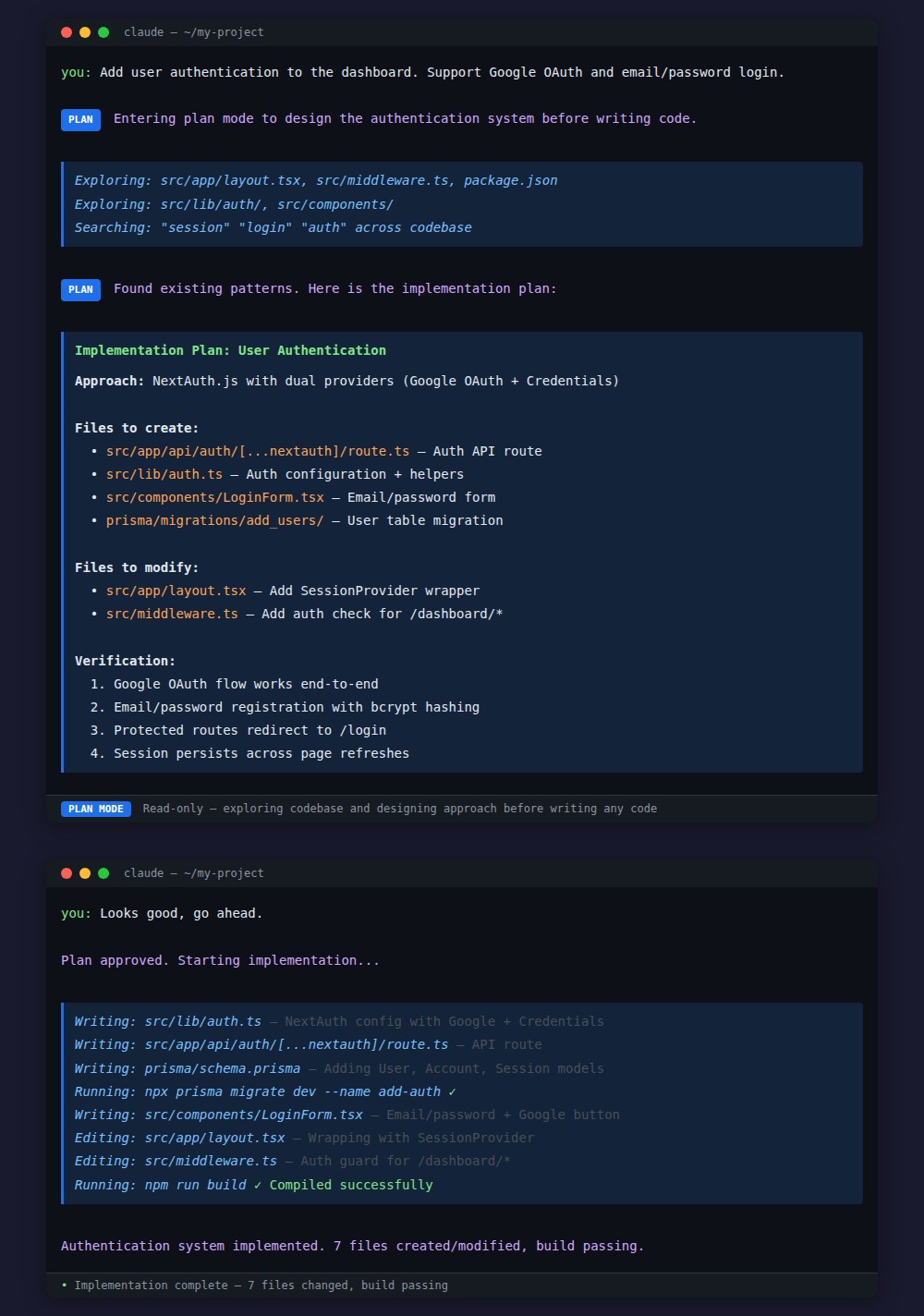
Claude explores the codebase, identifies the right approach, and presents a plan with specific files and verification steps — all before writing any code.
# how_i_use_it
Plan Mode has become the default way I start any non-trivial task. My workflow:
1. Describe the goal, not the implementation
I say "separate Floship code into its own app" not "move these 7 files and update these imports." Claude figures out the specifics during exploration.
2. Review the plan, not the code
It's much faster to review a plan than to review code. I can spot wrong approaches in seconds when reading a bullet-point plan. Spotting the same mistake in 500 lines of code takes minutes.
3. Redirect early, not late
If the plan is wrong, I say so. "Don't use a new library, we already have X" or "This should be 3 sprints, not one big change." The course correction happens before any code exists.
4. Approve and let it run
Once the plan is right, implementation is usually flawless. Claude follows its own plan, creates the files it said it would create, and runs the verification steps it committed to.
# when_to_use_it
Use Plan Mode for:
- New features touching multiple files
- Refactoring or architectural changes
- Tasks with multiple valid approaches
- Anything you'd want to review before it starts
- Complex bug fixes where root cause is unclear
- Work that affects shared systems or infrastructure
Skip it for:
- Single-line fixes (typos, obvious bugs)
- Tasks with very specific instructions already
- Quick lookups or research questions
- Anything that takes less than a minute
# why_it_matters
Plan Mode changes the economics of AI-assisted development. Without it, the feedback loop is:
ask → wait for code → read code → find mistakes → explain corrections → wait again
With Plan Mode, the loop becomes:
ask → review plan → approve → done
The plan review takes seconds. The code review takes minutes. Over a day of development, this compounds into hours saved. Over weeks, it fundamentally changes what's possible to build with a small team.
I now routinely complete in an afternoon what used to take days — not because the AI writes code faster, but because we almost never build the wrong thing anymore.
# how_to_activate
Plan Mode is built into Claude Code. There are two ways to activate it:
Claude Code is available at claude.ai/download. Plan Mode works on all plans, including the free tier.